What Is Matter, and Why Every Smart Home Box Suddenly Has the Logo

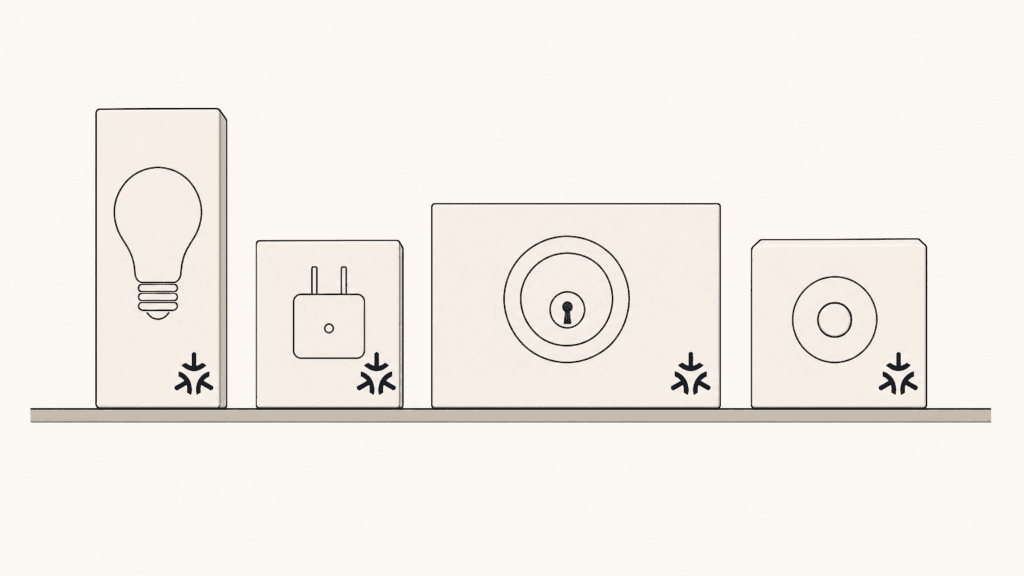
The Matter smart home standard is the small logo you keep seeing and nobody explains. Three arrows meeting in a triangle, printed beside the barcode on a bulb, a plug, a lock, a doorbell. The box does not say what it does. Neither does the listing. It is on almost everything now, including shelves that had nothing like it two years ago.
This guide covers what Matter is, why the logo spread so quickly, and what it promises once the device is in your house. The short answer is that a device carrying the logo will pair with any major platform and handle the basics, whatever brand is on the front. That floor is real and it is worth having. What the logo does not promise is that the one feature you are buying the device for will show up in your app.
What the Matter Smart Home Standard Is
Matter is a shared language. It is an open standard from the Connectivity Standards Alliance, and it sets out how a device describes itself, takes commands, and reports back, so a lamp made by one company and an app made by another can hold a conversation with no custom integration in between.
It rides on networks you already run. Wi-Fi, Thread, and Ethernet all carry it, with Bluetooth used briefly during setup. Control travels across your local network rather than out to a server and back, which is why a Matter device still answers a tap in the app while broadband is down. Reaching it from outside the house is the part that needs the internet.
Why Every Smart Home Box Suddenly Has the Logo
It Started Small and Kept Growing
Matter 1.0 arrived in October 2022 covering the easy things: lights, plugs, locks, thermostats, blinds, and basic sensors. Cameras were not in it.
Cameras came three years later in version 1.5, published on 20 November 2025 alongside closures and soil sensors, covering doorbell cameras, indoor and outdoor cameras, floodlight cameras, and pan and tilt models. Version 1.6 followed on 17 June 2026 and added no new device categories at all. It went after setup and coordination instead, with tap-to-pair NFC setup and a feature called Joint Fabric that lets two platforms co-administer one network rather than each keeping its own separate view of it.
Every one of those waves put the logo on a shelf that did not carry it before. That is the whole answer to the suddenness.
The Platforms Agreed, So a Manufacturer Certifies Once
The work started in 2019 as Project Connected Home over IP, with Amazon, Apple, Google, Comcast, SmartThings, and the alliance behind it, and was renamed Matter in May 2021.
What that buys a manufacturer is one certification instead of four separate integrations for four platforms. That is the commercial reason the logo spread so fast, and it is a sturdier reason than enthusiasm, because it survives a bad quarter.
It Runs on the Network You Already Have
Wi-Fi carries the hungry devices: displays, appliances, anything moving video. Thread carries the small battery ones: contact sensors, buttons, many locks. Thread is a low-power mesh, so those devices last on a coin cell in a way a Wi-Fi sensor never will.
Thread has one requirement worth knowing before you buy. A Thread device does not reach your network on its own. It needs a border router, a mains-powered device that bridges Thread to your home network, and one is often already in the house inside a smart speaker, a hub, or a streaming box. Our guide to smart locks for 2026 flags the same trade-off on the locks that run Matter over Thread.
⚠️ No border router, no pairing: If a product says Matter over Thread and there is no border router anywhere in your house, it will not pair. The box almost never mentions this.
What the Logo Certifies
A device carrying the Matter mark has passed certification with the alliance. That certification says it will pair with any major platform and answer the basic commands for its category. On or off. Locked or unlocked. Set to this temperature.
That is the floor, and the floor is the promise. It is not a claim about everything else the device can do.
What to Do When You See the Logo
Three checks, and none of them take long.
Name the feature you are buying the device for, then look for that specific feature on your platform’s own supported list rather than on the box. Pan and tilt, a particular sensor reading, an energy figure: those are the things that go missing.
Find out whether the device uses Thread or Wi-Fi. If it is Thread, confirm you have a border router before you pay.
Check whether the brand app is still needed for setup and for the settings you care about. On plenty of devices it is, and that is normal rather than a fault.
What Matter Does Not Fix
Platforms lag the standard. A manufacturer can ship a device built to a recent version while the app you use is still working through an older one, so a feature exists in the specification and nowhere you can reach it. This is the most common disappointment with Matter, and it is not the device misleading you.
Certification also says nothing about money. A Matter camera can still require a plan to keep its clips, because the standard governs how devices talk rather than how companies charge. The Hidden Math Behind Your Smart Home Subscriptions runs those numbers.
Your older gear does not join by itself either. Zigbee and Z-Wave devices reach a Matter home through a bridge or hub that speaks both, not by being certified after the fact.
Frequently Asked Questions
Do I need a hub for Matter?
For a Wi-Fi device, no, as long as you have a platform to control it from. For a Thread device, yes, in the sense that you need a border router, which is usually a speaker, hub, or streaming box you already own.
Does Matter work without internet?
Control runs over your local network, so lights and locks keep answering the app while broadband is down. Anything you do from outside the house still needs the connection.
Can one device work with Apple Home and Google Home at the same time?
Yes. Matter has allowed a device to belong to more than one platform for some time, and version 1.6 improved how those platforms share administration of it.
Will Matter replace Zigbee and Z-Wave?
Not for the gear you already own. Those devices keep working on their own hubs, and a bridge is what connects them into a Matter setup.
Check One Feature Before You Buy
Pick the feature that made you want the device, and find it on your platform’s supported list before you pay. The Matter smart home standard is a floor rather than a ceiling, and knowing which one you are standing on is the difference between a device that disappoints you and one that does what you expected.