Do You Need a Level 2 Charger at Home? Start With Your Daily Miles


The car is in the driveway and the dealer has already asked twice whether you want a quote for a Level 2 charger at home. In the trunk sits a cord with an ordinary household plug on one end. Nobody has told you whether that cord is enough.
Short answer: most people do not need a Level 2 charger at home on day one. If you drive a typical daily distance and the car sits in your garage or driveway overnight, a standard 120-volt outlet can usually put back what you used. Level 2 earns its cost when you drive long days, park for short stretches, or own a large battery.
Below: what the two levels are, the four things that decide it, and what a Level 2 install involves.
What Level 1 and Level 2 Charging Mean
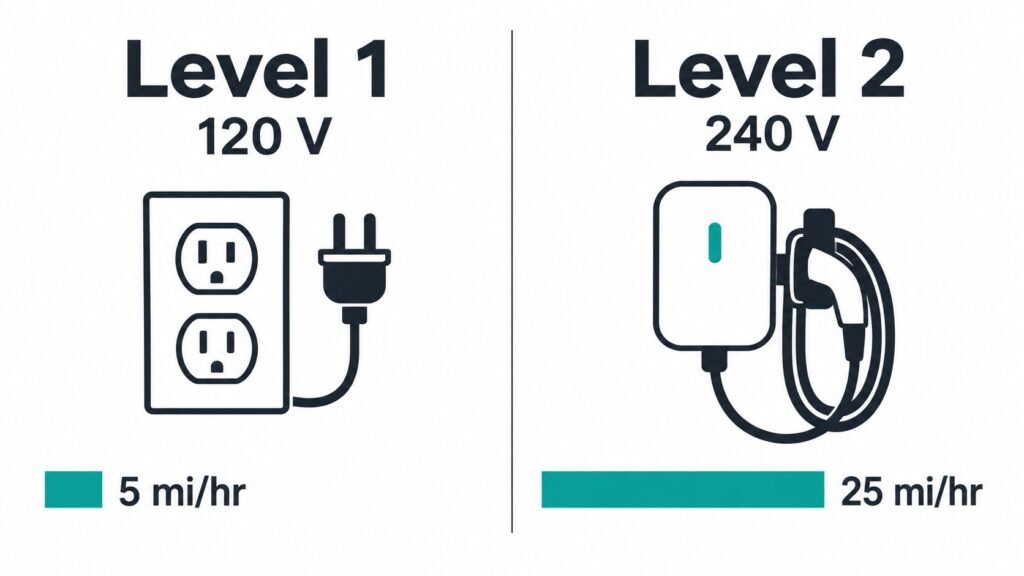
Level 1 is the plain wall outlet. It runs at 120 volts and adds roughly 5 miles of range for every hour the car is plugged in, according to fueleconomy.gov.
Level 2 runs at 240 volts, the same supply a clothes dryer or an electric range uses. The same source puts it at about 25 miles of range per hour on average, and anywhere from a few miles to around 40, depending on the car and the charger.
Both do the same job: refilling the car while it sits for hours. The U.S. Department of Energy notes that most EV drivers charge at home, overnight, on one of these two levels.
Do I Need a Level 2 Charger at Home? Four Things Decide It
How Far You Drive in a Day
The average licensed driver in the US covered 13,735 miles in 2024, per the Federal Highway Administration. That works out to about 38 miles a day. At 5 miles an hour, a Level 1 outlet covers that in under eight hours.
Averages hide the long days, though. A 90-mile round-trip commute needs about 18 hours on Level 1, which no overnight window provides.
How Long the Car Sits at Home
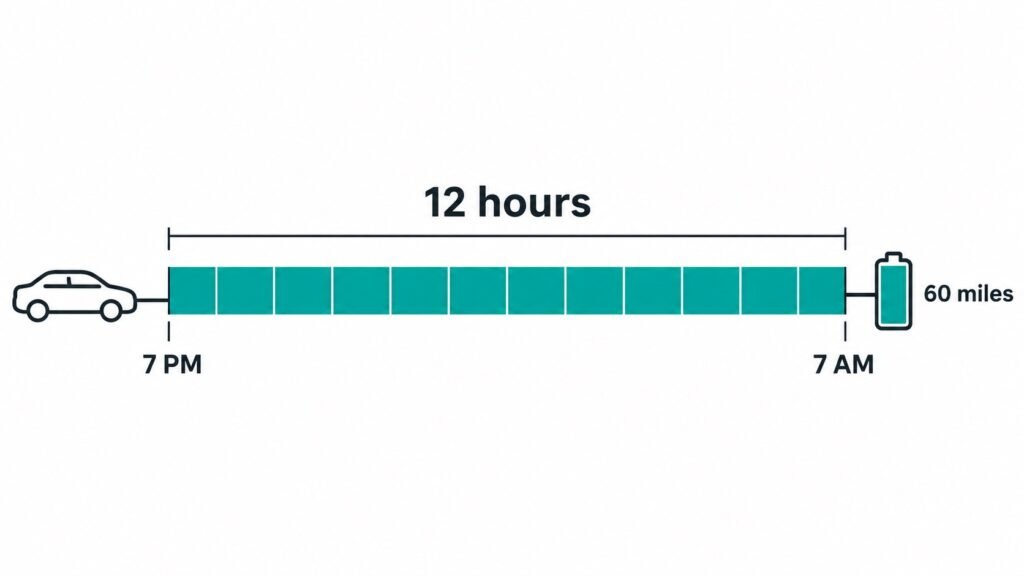
A car parked from 7 p.m. to 7 a.m. gets twelve hours on Level 1, or about 60 miles. A driver who heads out again after six hours gets about 30.
How Big the Battery Is
A small plug-in hybrid battery refills overnight on Level 1. A large pack drained by a road trip can take days.
Where You Park and What Outlet Is There
The DOE’s advice for Level 1 assumes an outlet on a dedicated circuit near where you park. A garage outlet shared with a freezer and a workbench is a different story.
⚠️ Plug it straight in: Do not run the charging cord through an extension cord, a power strip or a smart plug. An EV pulls a heavy load for hours at a stretch, which is the kind of load covered in our guide to the one thing a smart plug should never touch. Check your car’s manual for its own rules on the cord.
How to Run Your Own Overnight Number
You need two numbers: the miles you drive on your longest regular day, and the hours your car is parked at home before it leaves again.
- Multiply the parked hours by 5. That is roughly what Level 1 puts back.
- Compare it with your longest regular day.
- If Level 1 covers the long day with a few hours to spare, you can wait. If it falls short more than once a week, Level 2 starts to make sense.
A 46-mile commute and eleven hours parked gives 55 miles back. That works, with a little to spare.
💡 Plan for winter: fueleconomy.gov lists temperature among the factors behind charge times. If your garage gets cold, run the number with winter in mind.
What a Level 2 Install Involves
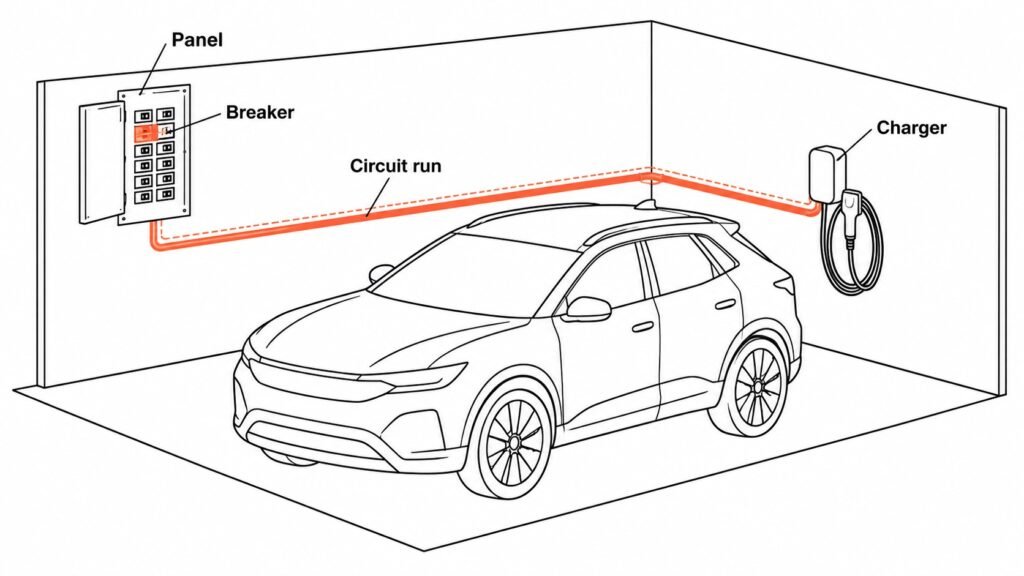
A Level 2 charger needs a 240-volt circuit of its own, and the hardware is often the smaller part of the bill. The cost depends on three things:
- The distance from your panel to where you park. A charger just through the wall from the panel is a short run. One in a detached garage is a long one.
- Whether your panel has room. A qualified electrician can tell you whether your home has enough capacity, per the DOE’s home charging guidance. If the panel is full, an upgrade can cost more than the charger.
- Permits. The same DOE page says installations must follow local and state codes, and many areas require a permit or an approved plan before work starts.
The National Electrical Code sets the rules. The circuit is sized for a continuous load, and since the 2020 edition, outlets for EV charging need ground-fault protection.
Many newer EVs use the NACS port, standardized as SAE J3400, while many home chargers use the older J1772 plug. The DOE says the two work together at Level 1 and Level 2 through an adapter.
The federal home charger credit ended for equipment placed in service after June 30, 2026, so check your utility for a rebate instead.
If a charger app will not join your WiFi during setup, read why smart devices fail to connect on 2.4 GHz vs 5 GHz.
Frequently Asked Questions
Do I need a Level 2 charger for a plug-in hybrid?
Usually not. A plug-in hybrid with a small battery can typically refill overnight on a standard outlet, and the gas engine covers the days it cannot.
What size breaker do I need for a Level 2 EV charger?
One sized at 125 percent of the charger’s continuous draw. A charger that draws 32 amps needs a 40-amp circuit. Your electrician sets the wire size to match the breaker and the length of the run.
Does a Level 2 charger save money?
Not on its own. Level 2 changes how fast the energy arrives, not how much energy your driving needs. Savings come from when you charge, so ask your utility whether it offers a lower overnight rate.
Try the Cord for Two Weeks
If your car came with a Level 1 cord, plug it into a dedicated outlet for two weeks and check the battery each morning. If it is back where you need it every day, you have your answer, and you can skip the Level 2 charger at home for now. If it falls short, you know how many miles you need back each night, which is the first question an electrician will ask.
Sources
- U.S. Department of Energy, Alternative Fuels Data Center: Charging Electric Vehicles at Home
- U.S. Department of Energy and EPA, fueleconomy.gov: Charging Your Plug-in Electric Car
- Federal Highway Administration: Our Nation’s Highways 2026, Licensed Drivers
- IRS: Instructions for Form 8911 (Rev. December 2025)
- DriveElectric.gov: Charging Connector
- Leviton: GFCI Requirements for EV Charging in the 2020 NEC