How to cool down a room fast without AC

Summer heat in a room without central AC can go from uncomfortable to unbearable fast, especially in a bedroom or home office where you actually need to function. The good news is you have more options than you probably think, and the right combination of products can make a serious difference without a major renovation. This guide breaks down exactly what works, what doesn’t, and which products are worth your money at every budget.
Fans vs. Portable AC: Know the Difference
This is the most important decision in this whole guide. Fans and portable ACs feel similar but do completely different things.
A fan moves air across your skin and speeds up sweat evaporation. Your body feels cooler, but the room temperature doesn’t actually change. On a day where it’s 78°F outside and 82°F inside, a good tower fan is all you need. On a day where it’s 95°F and humid, a fan just moves hot air around.
Some links in this post are affiliate links. As an Amazon Associate, SmartHomeLabs earns from qualifying purchases, at no extra cost to you. We only recommend products we’d genuinely use in our own home.
A portable AC uses refrigerant to pull heat out of the air and exhaust it outside through a window hose. The room actually gets colder. It costs more upfront, uses more electricity, and needs a window. But it’s the only no-installation option that genuinely drops air temperature.
| Option | Cools Air? | Cost | Best For |
|---|---|---|---|
| Tower Fan | No — cools body | $60–$120 USD | Mild heat, sleep comfort, daily use |
| Personal Fan (neck/waist) | No — cools body | $20–$50 USD | Outdoor work, on-the-go cooling |
| Portable AC | Yes | $300–$600 USD | Hot climates, high humidity, bedrooms |
| Ceiling Fan | No — cools body | $80–$200 + install | Long-term efficiency, living spaces |
| Blackout Curtains | Prevents heat gain | $25–$60 USD | Any room with sun-facing windows |
Tower Fans: What Specs Actually Matter
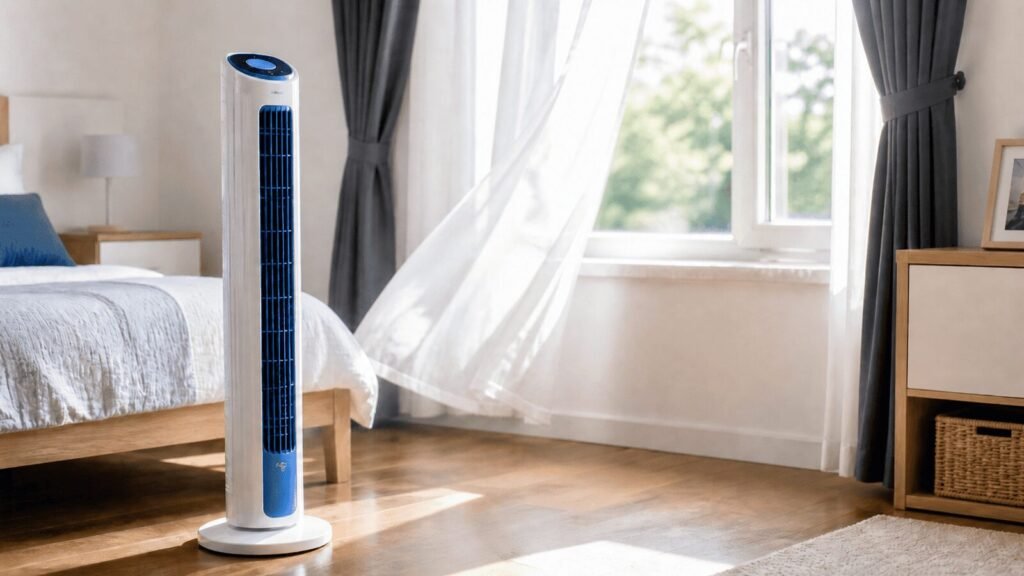
Not all tower fans are equal. The two specs that actually matter for daily use are airflow and noise. The Dreo 42″ Tower Fan moves 1,473 CFM, which puts it well above most fans in its price range. You feel the difference within seconds of turning it on.
For bedroom use, noise is just as important as airflow. The Dreo runs at 20dB on its lowest setting, which is close to a whisper. It also dims its LED display automatically after 30 seconds so nothing is glowing at you in the dark.

💡 Night cooling trick: Place the fan near an open window pointed inward before bed to pull cooler outdoor air in. Close the windows in the morning before the sun hits and your room stays noticeably cooler through the afternoon.
| Spec | Budget Fan | Mid-Range | Dreo 42″ |
|---|---|---|---|
| CFM (airflow) | 300–500 | 700–900 | 1,473 |
| Noise (low setting) | 40–50dB | 30–40dB | 20dB |
| Oscillation | 60–70° | 75–90° | 90° |
| Airflow reach | 10–15 ft | 20–25 ft | 36 ft |
Ceiling Fans: The Long Game
If you’re in a home you own or plan to stay in for more than one summer, a ceiling fan is worth serious consideration. Running one costs about $0.01 to $0.03 per hour compared to $0.10 to $0.40 for a portable AC. Over a full summer that gap adds up fast.
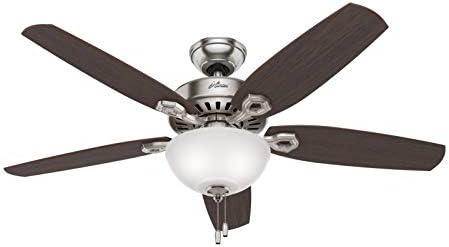
Installation takes a licensed electrician about 1 to 2 hours if there’s no existing wiring, or a confident DIYer about 30 minutes with an existing ceiling box. The main thing to check is that your ceiling box is rated for fan weight. Standard light fixture boxes are not fan-rated and can fail over time. Fan-rated boxes are inexpensive and available at any hardware store.
One setting most people miss: ceiling fans have a direction switch. Counterclockwise in summer pushes air straight down for a wind-chill effect. Clockwise in winter pulls warm air off the ceiling back down. It’s a 10-second change that makes a real difference in both seasons.
⚠️ Ceiling height matters: Fan blades need at least 7 feet of clearance from the floor. In rooms with 8-foot ceilings you’ll need a low-profile hugger fan with no downrod. A standard fan will hang too low and become a hazard.
Portable AC: When You Need Real Cooling
If your room regularly gets above 85°F or you live somewhere humid, a portable AC is the honest answer. It’s the only option on this list that actually removes heat from the room rather than just moving air around.
The Dreo Portable AC 318S covers rooms up to about 300 sq ft and handles both heat and humidity with cool, fan, and dehumidifier modes. The self-evaporating system means you won’t be emptying a water tank every few hours in most conditions. It’s also quieter than most portable ACs at 45dB, which matters if you’re running it in a bedroom.
Smart home control is built in and works with Alexa, Google Home, and Siri. The DREO app lets you set a sleep curve that adjusts temperature automatically through the night, so you’re not waking up at 3am to change settings.

⚠️ Window requirement: Every portable AC needs a window to exhaust hot air. Most kits fit standard sliding windows. Casement windows need a special adapter, so check your window type before buying.
Personal Fans: For Your Body, Not the Room
Neck fans and waist clip fans are purpose-built for outdoor use, commutes, or any situation where you’re moving around and can’t point a tower fan at yourself. They work by keeping airflow close to your skin, which is where cooling actually happens.
Neck Fans
The bladeless neck fan sits on your shoulders and sends airflow upward toward your face and neck. It’s hands-free and quiet enough to wear at a concert, on a flight, or during an outdoor workout. Battery life runs 4 to 16 hours depending on speed, which is enough for a full day out without recharging.

Waist Clip Fans
The portable waist clip fan is worth knowing about if you do physical outdoor work. Clip it to your waistband and it pushes air up under your shirt. Battery life runs 6 to 24 hours depending on speed, and it doubles as a flashlight and power bank, which is genuinely useful on a job site or camping trip.

⚠️ Expectation check: Personal fans cool your body through evaporation. If you’re not sweating, the effect is reduced. They’re not a substitute for room cooling.
Block Heat Before It Enters
Every fan and AC works harder when your room is already hot. Up to 30% of unwanted heat enters through windows, and blocking it before it builds is cheaper than cooling it down afterward.
NICETOWN’s thermal blackout curtains block sunlight and add a layer of insulation to the window itself. In a south or west-facing room in summer, that can reduce temperature by up to 20°F compared to bare windows. The grommet design hangs on any standard rod, and the pitch-black liner makes them useful as sleep curtains too if your bedroom catches morning light.

Keep them closed during peak sun hours, and open your windows at night to flush out the heat that built up during the day. Pair them with a tower fan and you’ll feel the difference the same day.
Frequently Asked Questions
How fast can a tower fan actually cool a room?
A tower fan doesn’t lower air temperature. It cools you by moving air across your skin. You’ll feel relief within seconds of turning it on. Running a powerful fan overnight in a well-ventilated room can gradually bring air temperature down by pulling in cooler outdoor air, especially if temps drop at night where you live.
Can I use a portable AC without a window?
Not effectively. Every portable AC exhausts hot air through a hose, and that hose needs somewhere to vent. Without a proper exhaust, the unit pushes heat back into the room and makes things worse. Some people vent into a drop ceiling or use a wall vent kit, but a window is by far the simplest solution.
Are blackout curtains worth it if I already have a fan?
Yes, because they work on the problem upstream. A fan cools you down after heat has built up inside. Blackout curtains stop that heat from entering in the first place. Using both together is more effective than doubling up on fans, and in a south-facing bedroom, the curtains can cut your cooling load before your fan even turns on.
What size portable AC do I need for my room?
A rough guide: 8,000 BTU ASHRAE covers rooms up to about 300 sq ft. Add roughly 1,000 BTU for every additional 50 sq ft. If your room gets direct afternoon sun or has high ceilings, size up. Always compare on the DOE SACC number rather than the ASHRAE number for accurate real-world performance.
How do I know if my ceiling can support a ceiling fan?
The existing electrical box needs to be rated for fan support, usually 35 lbs or more. Standard light fixture boxes are not rated for fans and can fail over time. Fan-rated boxes cost under $20 at any hardware store. If you’re not sure what’s in your ceiling, it’s worth checking before buying the fan.
You don’t need central AC to stay comfortable. You just need the right tool for your situation. A good tower fan handles most days. Add blackout curtains for rooms that bake in the afternoon sun. Step up to a portable AC when the heat gets serious. Stack all three and your room will feel like a different place by next week.
Keep Reading